
Saliva does several jobs at the same time
Saliva moistens and lubricates the mouth, helps clear food particles, and contributes to protecting teeth and oral tissues. These are related functions rather than three stages of a test. The same mouth can need an explanation of comfort, cleansing and protection; a single description of feeling dry does not measure any of them.
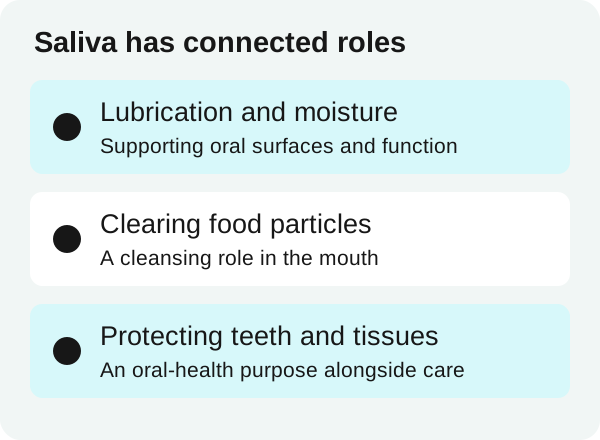
The text equivalent is straightforward. Moisture and lubrication concern keeping oral surfaces comfortable and supporting functions such as speaking and swallowing. Cleansing concerns moving food particles away. Protection concerns the contribution saliva makes to the health of teeth and oral tissues. Those purposes help explain why dental care remains relevant alongside a tooth-movement discussion.
A reported feeling and an assessed finding are different information
The ADA uses xerostomia for the experience of oral dryness. Its discussion distinguishes that experience from an objectively assessed reduction in salivary flow. A person can describe a dry feeling meaningfully without supplying the separate clinical information needed to describe gland function or flow.
NIDCR's patient explanation describes saliva's importance and a mouth that is not kept wet enough. The ADA's terminology helps when reading a more specific clinical account. Keep track of whether a sentence reports an experience or states an assessed finding; do not convert the broader description into your own test result.
Calling a report subjective identifies its source: it is the person's experience. It does not make the feeling unimportant or imaginary. Conversely, a record without a flow measurement does not establish normal flow, reduced flow or a diagnosis. Those conclusions would add information that the record has not supplied.
Leah's dry feeling matters without a flow result
In the continuing fictional example, Leah reports a dry feeling, and no salivary-flow measurement is included. Her report gives positive information about her experience. The missing measurement means this example cannot describe her flow.
Both points matter. Leah's experience can be discussed and taken seriously. There is no measured flow conclusion to copy into the account. Treating the missing measurement as normal would be an invention; treating it as a reason to dismiss the report would also change what is known.
The illustration explains general saliva functions, so it adds useful biological context without filling that missing clinical field. Nothing in its three labels grades Leah, chooses an appliance or shows what an assessment would find. The history lesson now adds another kind of information: what she can report about medicines and timing.
Sources for this lesson
Sources: NIDCR: Dry mouth · ADA: Xerostomia